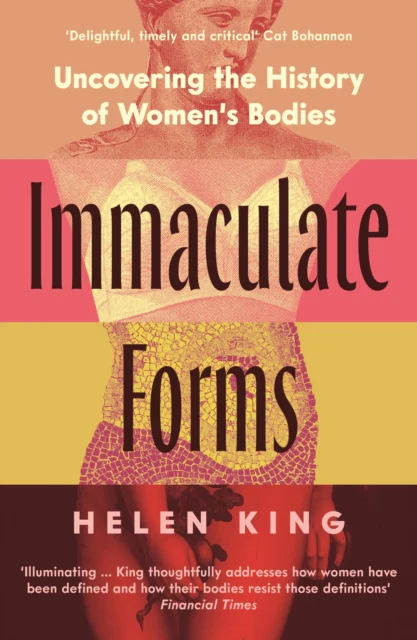
Immaculate Forms : Uncovering the History of Women's Bodies
Illuminating, thoughtful and scholarly' financial times
'Does a fascinating job of exploring the history of women's bodies' greg jenner
'Mind-blowing, fascinating stuff' bbc woman's hour
'Authoritative, rich and wide-ranging, this is an immensely impressive work of scholarship' guardian
Throughout history, religious scholars, medical men and - occasionally - women themselves, have moulded thought on what 'makes' a woman. She has been called the weaker sex, the fairer sex, the purer sex, among many other monikers. Often, she has been defined simply as 'Not A Man'.
Today, we are more aware than ever of the complex relationship between our bodies and our identities. But contrary to what some may believe, what makes a woman is a question that has always been open-ended.
Immaculate Forms examines all the ways in which medicine and religion have played a gatekeeping role over women's organs. It explores how the womb was seen as both the most miraculous organ in the body and as a sewer; uncovers breasts' legacies as maternal or sexual organs - or both; probes the mystery of the disappearing hymen, and asks, did the clitoris need to be discovered at all?
Illuminating, thoughtful and scholarly' financial times
'Does a fascinating job of exploring the history of women's bodies' greg jenner
'Mind-blowing, fascinating stuff' bbc woman's hour
'Authoritative, rich and wide-ranging, this is an immensely impressive work of scholarship' guardian
Throughout history, religious scholars, medical men and - occasionally - women themselves, have moulded thought on what 'makes' a woman. She has been called the weaker sex, the fairer sex, the purer sex, among many other monikers. Often, she has been defined simply as 'Not A Man'.
Today, we are more aware than ever of the complex relationship between our bodies and our identities. But contrary to what some may believe, what makes a woman is a question that has always been open-ended.
Immaculate Forms examines all the ways in which medicine and religion have played a gatekeeping role over women's organs. It explores how the womb was seen as both the most miraculous organ in the body and as a sewer; uncovers breasts' legacies as maternal or sexual organs - or both; probes the mystery of the disappearing hymen, and asks, did the clitoris need to be discovered at all?
Original: $37,522.07
-70%$37,522.07
$11,256.62Description
Illuminating, thoughtful and scholarly' financial times
'Does a fascinating job of exploring the history of women's bodies' greg jenner
'Mind-blowing, fascinating stuff' bbc woman's hour
'Authoritative, rich and wide-ranging, this is an immensely impressive work of scholarship' guardian
Throughout history, religious scholars, medical men and - occasionally - women themselves, have moulded thought on what 'makes' a woman. She has been called the weaker sex, the fairer sex, the purer sex, among many other monikers. Often, she has been defined simply as 'Not A Man'.
Today, we are more aware than ever of the complex relationship between our bodies and our identities. But contrary to what some may believe, what makes a woman is a question that has always been open-ended.
Immaculate Forms examines all the ways in which medicine and religion have played a gatekeeping role over women's organs. It explores how the womb was seen as both the most miraculous organ in the body and as a sewer; uncovers breasts' legacies as maternal or sexual organs - or both; probes the mystery of the disappearing hymen, and asks, did the clitoris need to be discovered at all?