
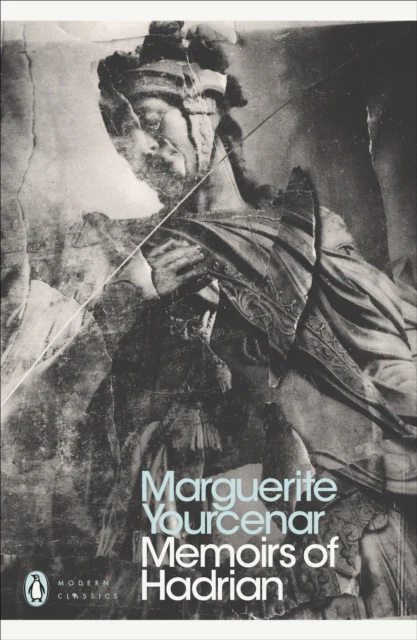
Memoirs of Hadrian : And Reflections on the Composition of Memoirs of Hadrian
Framed as a letter from the Roman Emperor Hadrian to his successor, Marcus Aurelius, Marguerite Yourcenar's "Memoirs of Hadrian" is translated from the French by Grace Frick with an introduction by Paul Bailey in Penguin Modern Classics.
In her novel, Marguerite Yourcenar recreates the life and death of one of the great rulers of the ancient world. The Emperor Hadrian, aware his demise is imminent, writes a long valedictory letter to Marcus Aurelius, his future successor. The Emperor meditates on his past, describing his accession, military triumphs, love of poetry and music, and the philosophy that informed his powerful and far-flung rule.
A work of detailed research and sustained empathy, "Memoirs of Hadrian" captures the living spirit of the Emperor and of ancient Rome.
Marguerite de Crayencour (1903-88), who went by the pen name 'Marguerite Yourcenar', was a Belgian-born French novelist and essayist, the first woman to be elected to the Académie française. Her first novel "Alexis" was published in 1929; in 1939 she was invited to America by her partner Grace Frick, where she lectured in comparative literature at Sarah Lawrence College in New York. When "Mémoires d'Hadrien" was first published in 1951, it was an immediate success and met with critical acclaim.
If you enjoyed "Memoirs of Hadrian", you might like Robert Graves's "I, Claudius", also available in Penguin Modern Classics.
'A timeless masterpiece ... every page is informed by her profound scholarship' — Paul Bailey, author of "Gabriel's Lament"
'Yourcenar conjures worlds. She can make us share passion — for beauty, bodies, ideas, even power — and consider it closely at the same time. She is that most extraordinary thing: a sensual thinker' — Independent on Sunday
Framed as a letter from the Roman Emperor Hadrian to his successor, Marcus Aurelius, Marguerite Yourcenar's "Memoirs of Hadrian" is translated from the French by Grace Frick with an introduction by Paul Bailey in Penguin Modern Classics.
In her novel, Marguerite Yourcenar recreates the life and death of one of the great rulers of the ancient world. The Emperor Hadrian, aware his demise is imminent, writes a long valedictory letter to Marcus Aurelius, his future successor. The Emperor meditates on his past, describing his accession, military triumphs, love of poetry and music, and the philosophy that informed his powerful and far-flung rule.
A work of detailed research and sustained empathy, "Memoirs of Hadrian" captures the living spirit of the Emperor and of ancient Rome.
Marguerite de Crayencour (1903-88), who went by the pen name 'Marguerite Yourcenar', was a Belgian-born French novelist and essayist, the first woman to be elected to the Académie française. Her first novel "Alexis" was published in 1929; in 1939 she was invited to America by her partner Grace Frick, where she lectured in comparative literature at Sarah Lawrence College in New York. When "Mémoires d'Hadrien" was first published in 1951, it was an immediate success and met with critical acclaim.
If you enjoyed "Memoirs of Hadrian", you might like Robert Graves's "I, Claudius", also available in Penguin Modern Classics.
'A timeless masterpiece ... every page is informed by her profound scholarship' — Paul Bailey, author of "Gabriel's Lament"
'Yourcenar conjures worlds. She can make us share passion — for beauty, bodies, ideas, even power — and consider it closely at the same time. She is that most extraordinary thing: a sensual thinker' — Independent on Sunday
Description
Framed as a letter from the Roman Emperor Hadrian to his successor, Marcus Aurelius, Marguerite Yourcenar's "Memoirs of Hadrian" is translated from the French by Grace Frick with an introduction by Paul Bailey in Penguin Modern Classics.
In her novel, Marguerite Yourcenar recreates the life and death of one of the great rulers of the ancient world. The Emperor Hadrian, aware his demise is imminent, writes a long valedictory letter to Marcus Aurelius, his future successor. The Emperor meditates on his past, describing his accession, military triumphs, love of poetry and music, and the philosophy that informed his powerful and far-flung rule.
A work of detailed research and sustained empathy, "Memoirs of Hadrian" captures the living spirit of the Emperor and of ancient Rome.
Marguerite de Crayencour (1903-88), who went by the pen name 'Marguerite Yourcenar', was a Belgian-born French novelist and essayist, the first woman to be elected to the Académie française. Her first novel "Alexis" was published in 1929; in 1939 she was invited to America by her partner Grace Frick, where she lectured in comparative literature at Sarah Lawrence College in New York. When "Mémoires d'Hadrien" was first published in 1951, it was an immediate success and met with critical acclaim.
If you enjoyed "Memoirs of Hadrian", you might like Robert Graves's "I, Claudius", also available in Penguin Modern Classics.
'A timeless masterpiece ... every page is informed by her profound scholarship' — Paul Bailey, author of "Gabriel's Lament"
'Yourcenar conjures worlds. She can make us share passion — for beauty, bodies, ideas, even power — and consider it closely at the same time. She is that most extraordinary thing: a sensual thinker' — Independent on Sunday